
Hello friends! I’m back from my big trip to Liberia, and excited to share some stories with you over the next few weeks.
23 of you donated money for art supplies (responding to this request). Thank you! 300 pounds of art supplies were brought over to the school on this trip–markers, colored pencils, pastels, paper, scissors, glue sticks, watercolor and tempura paints. Before I arrived, I had no imagination for just how out-of-place these art supplies would be. Liberia ranks as one of the world’s poorest countries, with most of its population surviving on 2-3 dollars a day and earning the moniker of “multidimensional poverty,” which means most of the population suffers from deprivation in health, education, and living standards. So, Crayola markers are not a thing here!
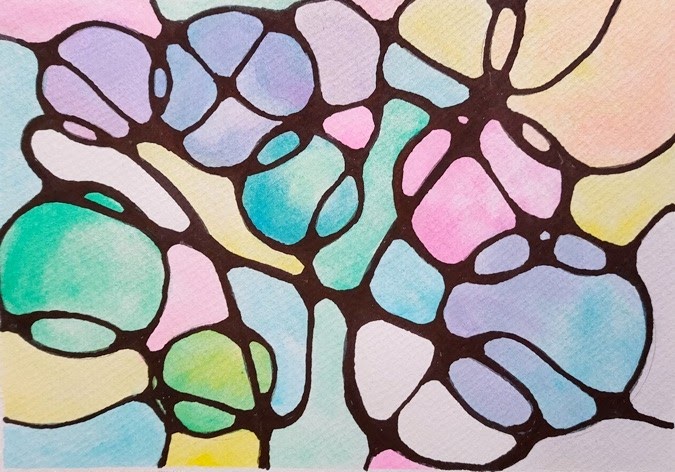
My friend Lisa in Bellingham, a teaching artist, taught me and some friends neurographic art recently. You make a few squiggles on a page, lines intersecting one another, then enhance the intersections. The result looks like a neural network. Then you color each segment in. In addition to being beautiful, the process has also been shown to calm the mind. It’s just the right percentage of structure/no structure to get the novice artist into a flow state. I thought this might be the perfect project to introduce to a group of fourth graders.
Jackie, Sandi (my travel partners and members of the Hope Project’s board and staff) and I meet Adama, the Dean of Instruction, in his office to gather the supplies. Adama and Desire, the school communications intern, serve as our interpreters for the project. English is the language spoken in Liberia, but the dialect is so unlike American English that I can probably only understand about 20% of what is said. We walk into a 90-degree classroom (with 1000% humidity!) and 60 excited fourth graders. I introduce myself and begin the demonstration.
When I went to tape my example onto the blackboard, packing tape was retrieved from the main office and the tip of a ballpoint pen was used to cut the tape. Not one pair of scissors in the classroom and, in fact, nothing but students and handmade desks. Most of the students have never seen markers before and we need to show them how to put the caps on and off. We don’t have enough markers for each student to have their own box, so we pass out one to each student and then have them trade when they want another color. (Volume: high!)
After I demonstrate and Adama interprets, Sandi and Jackie pass out paper and pens. (I almost went in and did this without them, which would have been laughable. Note to self: anything with 60 kids requires more hands.) The students sit there looking at me, nervous to start. We walk around encouraging them, noticing that they are trying to copy my exact squiggles from the example taped to the blackboard. Though they are very imaginative in their playground games (no toys, no playground equipment), this isn’t translating. They are nervous to do something wrong. We finally get them to loosen up a little, and the marker trades start happening furiously. Some of them start writing love notes to their parents or “I love school” on their drawings. And of course, there are a few students whose pieces display a flair for design–limited color palate or a distinctive line width.
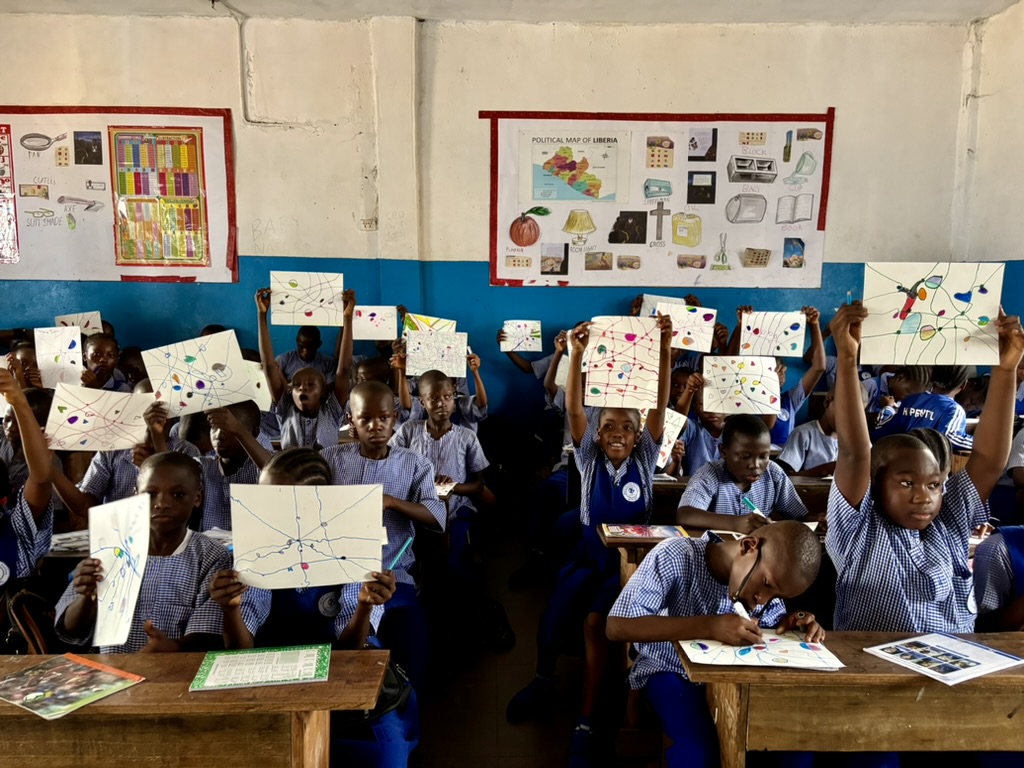
When our time is up, I ask them to hold up their creations. We see such joy and pride around the room. When they are dismissed, they run out into the courtyard waving their papers, showing their friends.
My friend Nicki and I have taught a couple creativity retreats for adults who don’t think of themselves as artists. I see this same impulse in the students–hesitation, nervousness, fear of doing it wrong. At the end of our retreats, Nicki and I have the participants share in the circle something they feel tenderly toward. That’s how these students felt, holding their drawings high, and that’s how I feel about this photo of them doing that.
In fact, “tenderness” is how I’d describe one of my biggest takeaways from my time in Liberia. They have so little, but they sure know how to put their arms around one another, share their food and paychecks, and pull a chair out for foreign visitors. The principal Mark was walking across the courtyard one day drinking from a water bottle. A 5-year-old student ran up to him and asked for a drink of his water, and he immediately held the bottle to her mouth and let her drink till she was satisfied. He wasn’t in a hurry. He didn’t think, “Well, if I give this child a drink, I’ll have to give the other 1400 students a drink, too.” He just responded with gentleness and generosity. May it be so with us, friends. Thank you for following along.